
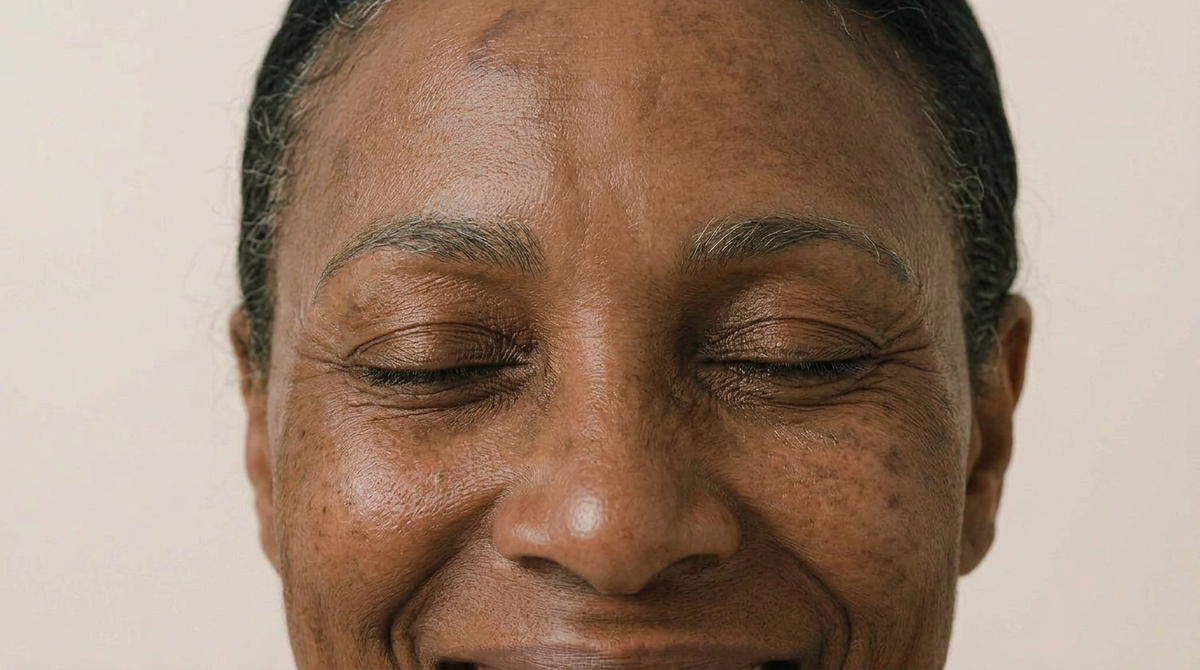
Somewhere around perimenopause, your skin quietly rewrote its own rulebook and didn't send you a copy. The moisturizer that worked for fifteen years suddenly isn't enough. Your skin is dry and breaking out at the same time, which feels like it should be illegal. Products you've used forever now sting for no reason you can identify.
You're not imagining it, and you're not doing anything wrong. Your skin is responding to a real physiological shift, and once you understand what's actually happening underneath, the fix gets a lot less mysterious. So here's the honest version, the same one we give clients in the treatment room.
![[Describe the image for accessibility and SEO, e.g., rich barrier cream texture swatch]](https://cdn.shopify.com/s/files/1/1001/1915/0957/files/Women_experience_menopause.png?v=1783640191)
What's Actually Going On Under There
Estrogen does a lot of quiet backstage work for your skin. It supports collagen production, helps your skin hold onto water, keeps oil production steady, and helps maintain the barrier that keeps moisture in and irritants out. When estrogen declines, all of those departments feel it at once.
Here's the short version of what the research shows:
- Collagen drops fast, then keeps drifting. Skin loses a significant chunk of its collagen in the first five years after menopause. That's why the change can feel sudden rather than gradual. It kind of was sudden.
- Your barrier gets leakier. The outermost layer loses lipids, so water escapes faster and irritants get in easier. This explains most of the mystery symptoms: the dryness, the new sensitivity, the "why does everything sting now" of it all.
- Oil production slows down. Less sebum means less of your skin's natural moisturizer. If you were oily your whole life and suddenly aren't, this is why.
- Hormonal breakouts show up anyway. With estrogen down, androgens get relatively louder, which can trigger breakouts along the jaw and chin. Dry and broken out at the same time. We agree it's rude.
- Skin gets thinner and slower to bounce back. Cell turnover slows, so skin can look duller because dead cells hang around longer than they used to.
In the treatment room, the pattern we see most is barrier-related. The majority of what clients call "menopause skin problems" live in that outer layer, which is genuinely good news, because the barrier is the part skincare can actually reach.
The Part Most Skincare Brands Won't Say Out Loud
Skincare cannot replace estrogen. No cream, serum, or "menopause line" changes your hormone levels, and any product implying otherwise is marketing, not chemistry.
“If you're weighing hormone therapy, that's a conversation for your doctor or a menopause specialist. It's outside what we do, and outside what any skincare brand should pretend to do.”
Here's what skincare genuinely can do, and it's not nothing: it can rebuild and protect the barrier, keep water in the skin, support the collagen you're still making, and manage the breakouts and sensitivity along the way. That covers most of what you're seeing in the mirror. So that's the plan.
Job One: Stop Scrubbing Away What Little Barrier You Have Left
The instinct when skin looks dull is to exfoliate harder. For menopausal skin, that instinct is usually backwards. Your barrier is already compromised, and stripping cleansers or daily acids make it worse. Switch to a cream or oil-based cleanser that removes the day without removing your skin's lipids along with it.

Job Two: Put the Lipids Back
This is the highest-impact step in the whole routine. Look for ceramides, cholesterol, and fatty acids, which are the actual building blocks your barrier is losing, plus humectants like hyaluronic acid and glycerin to pull water in. Niacinamide earns a spot here too, since it supports barrier lipid production and helps with the blotchiness.

Job Three: Support the Collagen You've Still Got
Retinoids remain the best-studied ingredient for stimulating collagen, and yes, menopausal skin can absolutely use them. The catch is that your thinner, drier skin has a lower tolerance than it did at 35, so the "start slow" advice isn't a suggestion anymore. It's the whole strategy. Twice a week, buffered over moisturizer, and build from there.
Peptides are a gentler supporting player if retinoids and your skin are currently not on speaking terms.
Retinal Blog


Job Four: Protect the Investment
Thinner skin is more vulnerable to UV, and UV is still the single biggest driver of visible aging, hormones included. A sunscreen you'll actually wear daily does more for your skin's future than any serum in this post. That's not us being dramatic. That's just the math.
The pick: [Product Name]
Why it's here: [Treatment-room detail, e.g., "No white cast on any of our clients' skin tones and it doesn't pill over the moisturizer above, which is rarer than it should be."]
Skip it if: [Qualifier]
How We Vet Every Product at For Your Skin
What About the Jawline Breakouts?
Treat them like the sensitive-skin breakouts they are, not like teenage acne. The harsh benzoyl peroxide and drying spot treatments from your twenties will wreck a menopausal barrier. Azelaic acid and low-strength salicylic acid used sparingly are your better tools, layered into the routine above rather than replacing it.
The pick: [Product Name]
Why it's here: [Detail]
Skip it if: [Qualifier]
When to Loop In a Doctor
We'll always tell you when something is bigger than skincare. See your physician or a menopause specialist if you're experiencing severe or painful hormonal acne, sudden significant hair thinning, intense persistent itching, or if you want to explore hormone therapy for symptoms beyond your skin. A good esthetician knows exactly where their lane ends, and this is ours.
The Short Version
Menopausal skin isn't broken. It's operating under new management, and the old routine wasn't built for it. Rebuild the barrier first, hydrate like it's your job, keep a retinoid in rotation at a pace your skin agrees to, and wear the sunscreen. Everything else is optional.
“We've already done the vetting on every product above, on real menopausal skin, over real months. That's the whole point of the shortlist.”
Everything in our [Collection Name] passed the same test: it had to work on real menopausal skin without wrecking the barrier, and it had to be pleasant enough that clients actually kept using it.
Want this as a one-page routine you can screenshot? Grab the free Menopause Skin Reset cheat sheet: the four jobs, the order to apply everything, and the "skip it if" notes, all on one page. Send me the cheat sheet

