
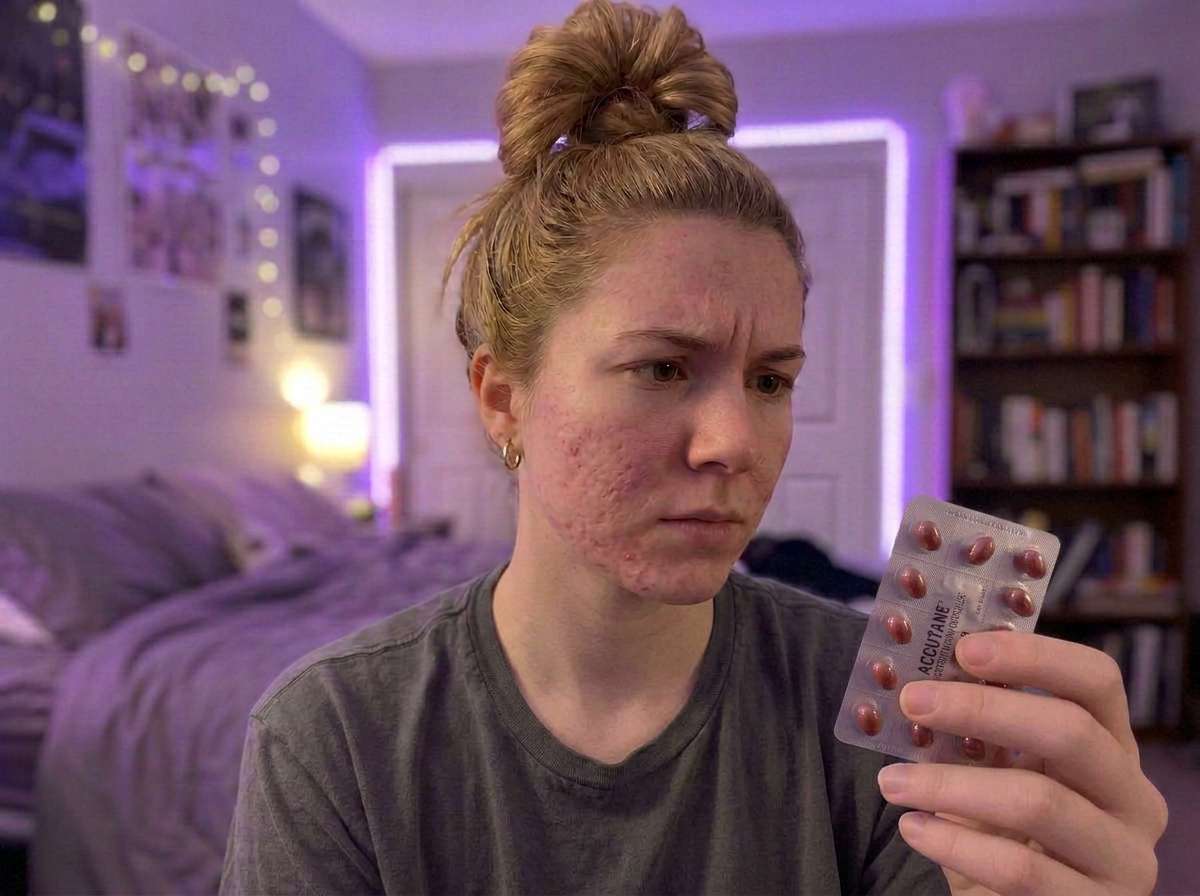
If you have ever fallen down an acne or anti-aging rabbit hole at 1am, you have probably met both of these names. Retinal is the over-the-counter option that estheticians keep quietly recommending, and Accutane is the prescription heavyweight with a reputation that precedes it everywhere it goes.
They are actually cousins from the same family, which surprises a lot of people. Both are retinoids, meaning they are built from vitamin A and speak the same language to your skin cells. The difference is in the delivery. Retinal is a cream you put on your face, and Accutane is a pill that travels through your entire body. That one distinction explains almost everything else in this post, including the famously long side effect list we are about to walk through honestly.
We sell one of these and will never sell the other, so consider this our unbiased tour of the family.
Retinal Blog


Retinal, the strongest thing we will recommend without a prescription pad
Quick refresher if you have not read our full retinal versus retinol breakdown: every retinoid has to convert into retinoic acid before your skin can use it. Retinol needs two conversion steps to get there, while retinal only needs one, which is why it works noticeably faster while staying gentler than prescription options.
In our treatment rooms, retinal is the graduation product. Clients who have adjusted well to retinol move up to it when they want faster movement on texture, tone, and fine lines, and clients with stubborn adult breakouts often do especially well because retinal has mild antibacterial properties that retinol simply does not have.
The honest catch is that it costs more than retinol, because keeping retinal stable in a bottle is genuinely difficult chemistry, and your skin still needs a proper easing-in period. Gentler than prescription strength does not mean gentle.
Accutane, the direct flight with a very long boarding announcement
Accutane is the old brand name for isotretinoin, an oral retinoid that dermatologists prescribe for severe, cystic, or treatment-resistant acne. Before we get into the side effects, credit where it is due: for the right person, it is genuinely life-changing. It remains the closest thing dermatology has to a cure for severe acne, and people who spent a decade fighting painful cysts often describe it as the thing that gave them their face back.
The reason the side effect list is so long is not that the drug is sloppy. It is that a pill cannot aim. A cream works where you put it, but a capsule circulates everywhere, and your skin is not the only part of you with vitamin A receptors. Your lips, eyes, liver, joints, and hair follicles all get the memo too.
The side effect list is not a scandal. It is just what honesty looks like when a drug is strong enough to work everywhere at once.
So here is the famous list, sorted by how likely you are to actually meet each item rather than alphabetically, which is how you get the wall of doom everywhere else.
- The near-guaranteed ones. Dryness is not a maybe, it is the mechanism. The drug shrinks oil glands everywhere, so expect seriously chapped lips, dry skin, dry eyes that make contact lenses annoying, and a dry nose that can lead to nosebleeds. Most people on isotretinoin develop a codependent relationship with a lip balm.
- The very common ones. Sun sensitivity goes way up, so sunscreen stops being a suggestion and becomes a rule. Many people also notice muscle aches or joint stiffness, especially if they train hard, along with some initial purging where acne temporarily looks worse before it improves.
- The monitored ones. Isotretinoin can raise cholesterol, triglycerides, and liver enzymes, which is exactly why dermatologists order regular blood work through the course. These changes usually reverse after finishing, and they are the reason nobody legitimate hands this drug out casually.
- The serious ones. Isotretinoin causes severe birth defects, with no exceptions and no safe window, which is why patients who can become pregnant are enrolled in a strict monitoring program with monthly pregnancy tests and required contraception. There are also reported associations with mood changes in some patients. The research on whether the drug itself causes this is genuinely mixed, but every good dermatologist screens for it and takes it seriously, and so should anyone starting a course.
- The rarer ones. Temporary hair thinning, reduced night vision, headaches, and slower wound healing all show up in a minority of patients. The night vision one matters if you drive a lot after dark, and the wound healing one is why derms tell patients to postpone waxing and certain treatments during and shortly after a course.
If reading that felt like a pharmaceutical commercial voiceover, that is fair, but notice what the list actually is. It is mostly dryness, monitoring, and a handful of serious risks that a good prescriber manages closely. It is neither the horror story the forums suggest nor the casual quick fix some people treat it as.
So who actually belongs on which one
Here is the honest sorting, which is the same conversation we would have across a treatment table.
Accutane territory looks like painful cystic acne, acne that scars, or acne that has already outlasted good topical routines and possibly antibiotics. If that is you, no over-the-counter product, including anything we sell, is the responsible first recommendation. A dermatologist is. We would rather lose that sale than pretend a serum can do a systemic drug's job, and any shop that suggests otherwise is telling on itself.
We would rather lose that sale than pretend a serum can do a systemic drug's job.
Retinal territory looks like everything below that line: standard adult breakouts, texture, uneven tone, early fine lines, and the maintenance years after an Accutane course is finished. That last one is a real and underrated use case, because skin that has been through isotretinoin eventually needs a long-term plan, and a well-formulated retinal is often it, with your derm's blessing on timing, since skin stays sensitive for months after a course.
Neither, for now, looks like a wrecked moisture barrier, pregnancy or nursing, or a routine that changes every week. All retinoids, oral and topical alike, are off the table during pregnancy, and that part is not negotiable.
The pick: [Product Name]
Why it's here: [Fill in a real treatment-room observation, e.g., the rich, zero-fragrance moisturizer you recommend to clients mid-Accutane, when their skin wants comfort and absolutely nothing clever]
Skip it if: [Fill in a real qualifier, e.g., your skin is oily and not on medication, since this will feel like too much blanket]
Where our lane ends
Everything about isotretinoin itself, including whether you are a candidate, dosing, side effect management, and when to start topicals afterward, belongs to you and a board-certified dermatologist. Estheticians do not diagnose and do not advise on prescriptions, and any esthetician who blurs that line is doing you a disservice. Our lane is the over-the-counter side and the long-term maintenance plan once your derm gives the all clear, and we are very comfortable staying in it.
The Short Version
Retinal and Accutane are relatives with completely different job descriptions. One is a topical you can buy from people like us for the everyday concerns most of us actually have, and the other is a serious systemic medication that belongs entirely to you and your dermatologist, long side effect list and all. The list is long because the pill works everywhere at once, not because anyone is hiding something, and we happen to think that same honesty should apply to the stuff in pretty bottles too. If retinal is your lane, the vetting is already done: we tested it on real client skin before it earned a spot here.
Ready for the topical side? Everything in our Correction Collection passed the same real-skin test in our treatment rooms before we agreed to stock it, retinal included.
Not sure your skin is ready for a retinoid at all? Grab the free Retinoid Readiness Checklist, a one-page self-check covering your barrier, your SPF habit, and the five signs you should wait.

